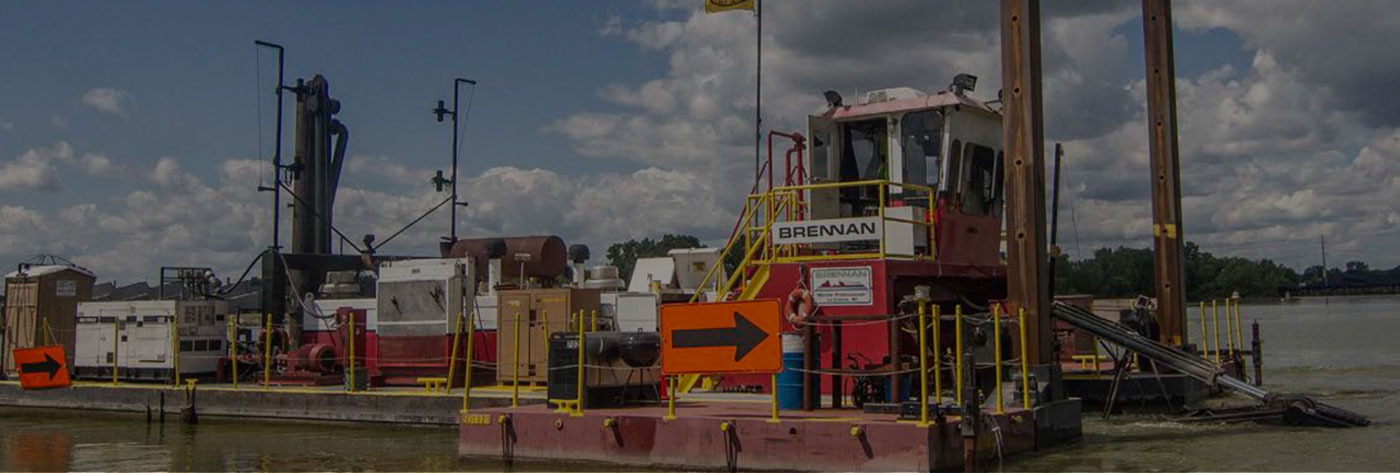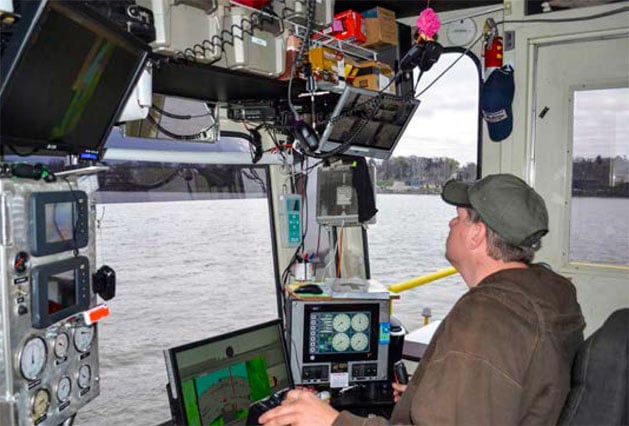
Brennan has reinvented the concept of inland waterway hydrographic surveying. Using the latest technologies and custom-designed vessels, we have become an innovative leader in underwater mapping and modeling. We have been able to take state-of-the-art technology and apply it to shallow water conditions, a feat that has proven difficult for other survey firms.
Brennan’s full-time, dedicated staff of marine surveyors and engineers has experience in collecting, processing, and assembling survey data to create 3-dimensional models of subaqueous bottoms. These surveys are often conducted on environmental remediation projects as a regular measure of progress. They are a regular comparison between reported and measured production quantities. Throughout all of our remediation projects, QA/QC surveys are run daily to create progress models that are constantly compared to pre-dredge models to ensure accuracy and calculate dredge quantities. The data from these surveys are then loaded into our dredge and capping systems to give our operators continuous updates on their progress through the designed dredge and capping prisms.
Types of Hydrographic Surveys
- Multi-Beam Echo Sounder
- This method of collecting data is the most effective way of creating detailed 3-dimensional models of the river and lake bottoms. It collects several soundings at once and ties them in with RTK-GPS units to create a very accurate depiction of subaqueous surfaces. – Learn More
- Single-Beam Echo Sounder
- This method uses a single sounding device to collect accurate depth measurements and tie them in with RTK-GPS systems. Data points collected with this system use a greater degree of interpolation to create a 3-dimensional model; however, it can be very cost effective in gathering important sounding information. –Learn More
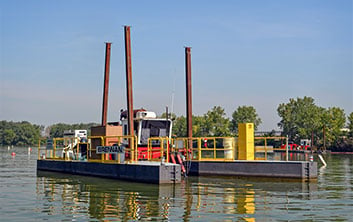
Our custom-designed survey vessels can work in very shallow conditions, inclement weather, and around obstacles with heightened maneuverability. They are specifically designed to work on the inland waterways, allowing them to access shallow areas, and remain stable while working around debris, dredge pipe, or other obstacles typically found in the riverine environment. They have also been designed to facilitate sediment sampling, a task that is often conducted during sediment remediation projects.

Typical Hydrographic Survey Applications
- Pre-dredge and Post-dredge
- Quality Assurance
- Subaqueous Modeling
- Dredge Prism Updates
- Sediment Characterizations
Equipment Used
- Real-Time Kinematic Global Positioning System (RTK-GPS)
- Single-Beam Echo Sounder or Multi-Beam Echo Sounder
- Light Detection and Ranging (LiDAR)
- Side Scan Sonar
- Sector Scan