Traditionally when it comes to installing sheet piling around a bridge pier or along an embankment we think of steel sheet piling. Steel sheet piling are the most common, and have been one of the most effective methods of installing a deep foundation. They have a long history of providing a robust barrier through shaped, interlocking sheets that can last for 75+ years.
On the other hand, when deep foundations are not required we search for solutions such as concrete retaining walls, soldier pile walls, or even concrete consolidation of historical masonry walls. These solutions are a cost effective approach, however longevity can be sacrificed.
There is another solution that combines the strength of a sheet pile wall, the value of a concrete retaining wall, and modern-day technologies. This involves the use of vinyl sheet piling. Vinyl sheet piling comes in similar shapes and sizes as steel sheet piling, however it is made from Polyvinyl Chloride (PVC) so it resists degradation common in concrete walls.
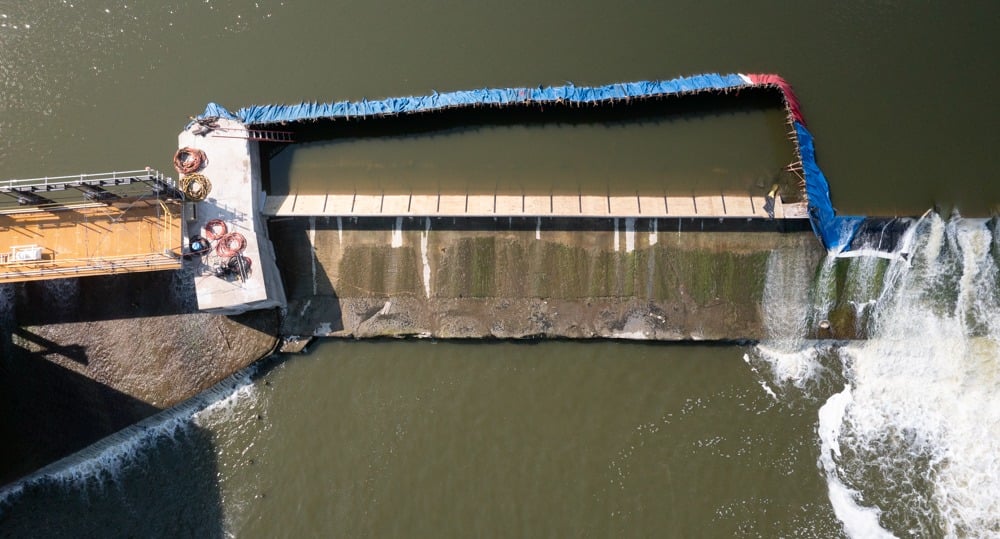
Vinyl sheet piling can be used in several applications; however one of the most effective applications that we at Brennan have found is its use in concrete structure reinforcement. In this application it is effectively used as a leave-in-place formwork that helps protect newly placed concrete in above and below-water repairs. Vinyl sheet piling can be placed without the use of heavy equipment around an existing structure such as a bridge pier. It is secured in place using a steel waler system and rebar. The toe of the sheeting can be secured using grout bags. 
Once secured, the concrete can then be placed using traditional methods, or as preplaced aggregate concrete (PAC). The pressurization of installing the grout in the PAC method will consolidate the existing structure, increasing its strength.
The result is an aesthetically pleasing repair that combines long-lasting surface protection, with effective strengthening of the existing structure. This method is cost effective and will last longer than traditional concrete retaining walls.
When considering our infrastructure often times our inland waterways are forgotten. What most people may not know is that barge transportation is as important as railways or highways. Barges are responsible for moving more than 60% of grain exports throughout the United States. Barge transportation is a very efficient mode of moving bulk materials such as grains, coal, and other commodities. As stated by the National Waterways Foundation 1,750 short tons of dry cargo fit into one barge which is otherwise 16 rail cars or 70 trucks.
Currently the U.S. Army Corps of Engineers is looking to reduce operating hours at 63 locks because of reduced federal funding for operation and maintenance. A reduction in operating hours would only further heighten congestion, stall barge traffic, and delay delivery time of commodities transported via the inland waterways.
Current project delays and budget overruns are resulting in delayed starts and loss of funding for other projects. This puts locks at risk of further deterioration and possible closures. Lock failures would cause a diversion of barge traffic to rail or long haul truck however the increase in transportation costs would offset the advantage of Midwestern producers. Whether the lock closure lasts for two weeks or one year, the total volume of grain transported is decreased. According to an analysis of six focus locks conducted by Texas Transportation Institute, a lock failure could cost producers anywhere from $900,000 to $45 million and barge companies could lose between $2.2 million and $162.9 million in revenues contingent on length of closure. Furthermore, utilizing rail and truck would deplete our infrastructure and increase costs to our economy. As it is over half of America’s federal-aid highways are considered to be in less than satisfactory condition.
In a hypothetical case study done by Texas Transportation Institute, if the Mississippi and Illinois Rivers were shut down in the vicinity of St. Louis, highway costs would increase from $345 million over $721 million over 10 years. Truck traffic would increase by 200%, traffic delays would increase by nearly 500%, and maintenance costs would increase by 80-93%.
It is evident that our inland waterways play an important role in our economy. Here in the Midwest where grain is our primary export it is especially important that our locks and dams are maintained for the success of our economy and farmers.
Hydrographic surveys are a very effective way to map the bottom of a river, lake, or other water body. By using some of the latest technologies a 3-dimensional model can be developed to show contours, obstacles, scour areas, and large debris. Even in the most turbid conditions, a hydrographic survey done correctly can be very effective.
1. Prepare for the survey MOD-resized-600.jpg)
Before beginning, make sure all the equipment is ready to go. Batteries should all be charged and the boat should be fueled. All pre-survey data should be loaded into the computer. This data includes a CAD outline of the water body, track lines for the vessel to follow, and verified quality control points to check into. Also ensure that you become familiar with any potential obstacles in the area such as bridges, docks, sand bars, etc.
2. Run straight lines
Track lines are very important, especially when using a single-beam system. As you navigate the boat you want to run it along your pre-mapped course by following your track lines as closely as possible. In post data processing, consistent, parallel lines will lead to the best interpolation results.
3. Go the distance
When working around seawalls ensure that data points are gathered as closely as possible to the wall. This means you have to run the boat right up to the wall. On a long survey this can be time consuming and cutting corners can be an attractive approach, but the close shoreline data is sometimes the most important.
4. Process data right away
Once you have the data, process it as soon as possible. Waiting for a lenghty period of time can have a significant impact on your results, especially when working around a dredge project. Processing the data quickly is also important in case you have to go out and collect more to fill in any holes. Bottom conditions will generally by similar if you gather your data in close time intervals.
While running a hydrographic survey take your time. It is always better to have too much data than not enough. You never know what you may find!
Our final installment of becoming a tow boat master focuses on the demanding schedule that one will encounter if he or she chooses this path. It is not an easy schedule, but the rewards have drawn many.
Schedules
Although life of river master is very rewarding there are many challenge
s, and schedules can be one of them. A fleeting and switching master generally will switch back and forth from days to nights working through weekends and holidays. A short haul towing master could spend several days at a time on smaller vessel often making challenging crew changes miles from their home. Line haul vessels also have a schedule that is very challenging to masters and crews because they generally have to work 30 days in the row, or sometimes more. While working they also have live on the vessel, not an easy task for a family man.

Reward
The hard work and responsibility put into becoming a master is culminated with great reward. Many masters make six figures annually all from a trade they learned through on the job training while being compensated for their work. You will also have the reward of being able to work along the scenic inland waterways. The reward of a sunrise or sunset, the beauty of nature living in your work area, or the simple rock formations and changes in terrain along the river are indescribable. The beauty of the Mississippi that Mark Twain wrote about so many years ago still exists today!
We continue our series on becoming a Master
of Towing Vessels by next addressing the duties in which this person is responsible. Our last entry left off with some fun statistics that outlined the enormity of cargo in which an average sized tow can transport. This statistic, supplied by the National Waterways Foundation, stated that an average sized, 15 barge tow can transport as much as 216 rail cars, and 1,050 semi-tractors! Just one barge alone can carry 58,333 bushels of wheat, enough for 2.5 million loaves of bread!
Now that we have defined the size of the loads, let’s look at the medium in which it is transported. A river is like a living, breathing organism. It changes, it moves, it causes havoc, even for some of the most experienced pilots. It takes a very well disciplined, knowledgeable person to handle such a large quantity of steel and cargo as it is being thrown around by currents and wind. Not to mention the necessity to maneuver through bridges, dams, and around navigational structures can make hair go gray at a young age.
So now you know what you’re up against. Here are some of the duties in which a Master of Towing is responsible.
Duties
A Master of a Vessel means much more than just owning a license. A master’s first and foremost responsibility is the safety of his crew. He or she is expected to lead daily drills and safety meetings, and to correlate his or her knowledge and experience into safety training for the crew. On an average day in fleeting operations a master can move 30 to 40 thousand tons of cargo! This means that a well-trained crew that holds safe practices in the highest regard is critical for the success of a towing vessel.
A master is also responsible for knowing all the regulations to which he or she and their crew must comply. These rules could come from a number of governing bodies in this highly regulated industry. Agencies such as the U.S Coast Guard, U.S. Army Corps of Engineers, OSHA, and the Environmental Protection Agency are heavily involved in setting industry rules and regulations.
A master is responsible for the upkeep of the vessel in which he or she is in charge. These vessels are typically some of the largest company assets where housekeeping and preventative maintenance performed under the Master's watch are instrumental to its long-term usage.
In switching and fleeting the master also plays a key role in customer service. He or she has to deliver the freight or empty cargo hopper in a safe and timely manner and is often the field contact that represents his or her company. For this reason a master must be organized and possess good communication skills. A Master of Towing must also be a Master of Communication in order to succeed!
Check back next week for the third installment of becoming a Master of Towing Vessels!
Have you ever wondered how you can get a job running a tow boat up and down the Mississippi River? Did you know that there is actually a shortage of river boat pilots? 
To become a Master of Towing Vessels, you have to follow a standard process that takes time and committment. This process will be described in a series of three blog posts that will show you how one becomes a tow boat pilot and what it entails. Each Master shoulders enormous responsibilities when navigating the ever-changing inland waterways of the United States. If you have ever read a Mark Twain novel you will appreciate the skills and challenges that await!
Three topics will be covered:
- Qualifications - What you need to succeed
- Duties - The responsibilities placed on your shoulders
- Schedules - Its not a 9 to 5 job!
Qualifications
First, to become a licensed tow boat master on the western rivers or great lakes you must meet a standard of criteria set forth by the United States Coast Guard (USCG). In switching
and fleeting operations on the western rivers you are required to have, at a minimum, a license as a Master of Towing vessels (Limited). This license requires a minimum of 540 days as a “deckhand”, and an additional 540 days steering the vessel. This is then followed by a practical exam by a USCG approved examiner.
In a short haul towing environment a master is required to have a license as Master of Towing Vessels , this license requires 1,440 total days of service of which 540 of them have to be steering a vessel and 360 of those days must be on line-haul towing vessels. Each licenses require a series of written tests you must pass at a USCG approved exam center.
The USCG has placed heavy emphasis on service time, both decking and steering , to issue masters licenses in order to maintain the industry's position as the safest form of commodity transportation in the US. The service time to become a captain of a towing vessel is more stringent that even that of an airline pilot, where most airlines require 3,000 hours of flight time! Why is this so demanding? Well, a 15 barge tow carries as much cargo as 216 rail cars, and 1,050 large semi trucks!
Recently Susan Pastor with the U.S. Environmental Protection Agency wrote an article in the Spring 2012 edition of the Fox River Current titled “Latest Technology Guides Hydraulic Dredge”. The article was about the use of a Real Time Kinematic Global Positioning System (RTK-GPS) to aid the dredge operator in removing contaminated sediments from the Fox River in Green Bay, WI. In the article she writes about the use of the system and how it improves the accuracy in which a dredge operator can remove targeted sediments to designated depths. These operators can view their progress in real time using pricey, high accuracy equipment.
The reason a system like this is so beneficial to environmental dredge projects is because it can substantially reduce the overall cost. Due to the high cost of treatment and disposal of contaminated sediments, it is imperative that the quantities be minimized. Taking clean, underlying soils with the contaminated sediments will only inflate the overall cost of the project because once mixed, it all needs to be treated. The RTK-GPS system used in combination with customized software, positioning sensors, and an experienced operator are necessary to effectively remove all the contaminated sediments, while minimizing removal of clean sediments.
This theory goes against the grain of the entire concept of dredging. Since its inception, the goal has always been to remove as much material, as fast as possible. It is known as maximizing production. However, to maximize production in environmental dredging, one must surgically remove these sediments as efficiently as possible. High-accuracy equipment, such as RTK-GPS, and an experienced operator are the best ways to accomplish this extremely difficult task.
Preplaced aggregate concrete (PAC) is not a new concept. In fact it is a method of concrete placement that has been around since the late 1930’s. However, it is often overlooked as an option to repair dams and bridge piers. In fact, it is one of the most effective forms of underwater concrete repair.
What’s the difference?
Conventional concrete is placed as a composite aggregate and cement-grout mixture. This means the aggregate and cementitious grout components are combined before the concrete is placed into formwork. PAC is different than conventional concrete methods because its components are placed in separate steps. Like the name implies, the aggregates are placed before the grout mixture. This leads to several advantages.
Advantage #1
Because the aggregate is washed and placed into the formwork before the grout is injected, the aggregate-to-cement ratio is maximized. According to the American Concrete Institute this reduces shrinkage which can lead to higher bondability with existing concrete surfaces. Higher bondability and less shrinkage results in less cracking!

Advantage #2
Another advantage is that PAC disallows material separation when being placed, especially when the formwork is partially or fully submerged in water. Once the aggregate is placed, grout injection begins at the bottom of the formwork, and progresses vertically at separate injection points. Any water in the formwork is displaced as the grout fills all the voids between the aggregate, creating a homogenous mixture. A homogenous mixture leads to a stronger repair!
Advantage #3
Finally, when placing PAC, there is little need for heavy equipment. The aggregate can literally be washed into place using a sluice pipe. Then grout can be injected using a grout pump. This is especially beneficial on small bridge pier or dam repair projects because most of the equipment can be left onshore. Materials are transported to the repair site through temporary PVC sluice pipes and grout hoses. Fewer pieces of equipment will lead to a lower cost repair!
It is inevitable. Over time a river will dig out the land over which it flows. That’s why we have valleys, coulees, and scour problems on every structure we place in its path. As James Eads would mostly likely attest, rivers cannot be fully tamed and scour repair will always be a constant struggle for anything set in their way. Bridge piers are one of the most vulnerable structures to scour problems.
This leads to the periodic ritual of performing underwater inspections to ensure the bridge’s structural integrity remains intact. Traditionally completed by trained divers, the process can be frustrating because underwater visibility is often very limited. Scour damage and voids can be missed easily, or even worse, miscommunicated by the diver. Also, areas covered in rip rap can hide critical problems developing underneath. There is a solution that can create a detailed image of the underwater portions of the bridge pier and any scour problems around it.
A sector scan can capture an acoustic image of the pier that will most often show any areas of concern. This image will help pinpoint areas that require diver concentration. It can be included in inspection reports to show potential problems and potentially can eliminate the need for a full diver inspection altogether.
Sector scans can be carried out easily with a two-person crew and small work boat. The images can be captured quickly and digitally combined with above-water photos to create a composite image of the entire structure. The next time you are thinking about a bridge pier inspection, consider a sector scan.

Can you guess what's wrong with this bridge???
Posted by
Ryan Olsen on Fri, Apr 27, 2012 @ 08:21 AM
One of the key elements that all construction companies will face is how to prepare their crews for potential emergency situations at remote worksites. As a
Health and Safety manager, an everyday important component for managing the safety of its crews, regardless of their size, is preparing them for potential emergency situations. There are many considerations that go into to each unique job and each must be analyzed separately.
Therefore, it’s important to be

involved in every stage of the work activity. Get involved during preconstruction meetings and during job startup to become more familiar with the scope of work and the environment. It’s important to visit the jobsite during the initial stages of construction to analyze what types of emergency scenarios can be predicted. After that, regular site visits and updates from the site will help identify new or existing concerns and issues. Below are three key elements to consider when preparing for emergencies at remote worksites.
1. Identify and anticipate potential hazardous conditions relevant to the site
- Adverse Weather – Is there likelihood for tornadoes, temperatures extremes, strong winds, flooding, snow storms?
- Air quality or Visibility issues – will this play a factor and increase the danger of the tasks being performed?
- Potentially hazardous tasks being performed – Is the work being performed in a dangerous environment or one that has various exposures?
- Size of the crew and worksite – Is the site large and spread out and are there enough people around to know if someone is missing or needs emergency care?
- Methods of communication – if emergency assistance is needed, how will you contact responders or other crew members? Are 2-way radios available or do cell phones have service?
- Response time – In remote locations, the time it takes for responders to arrive might be lengthy. Are you able to respond to an emergency until responders arrive?
- Difficult access to worksite – Accessibility for emergency responders may be an issue. Are you familiar with the area and can direct responders to your location if needed and no address is available?
2. Analyze each situation that might lead to an emergency
- What emergency supplies may be needed in this scenario?
- What is the likelihood and severity of the potential incidents?
- Do they have a safe storm shelter or a place to hide from the elements?
- What are the surrounding conditions? Does the worksite present additional chemical or biological hazards?
- What type of emergency evacuation equipment should be available?
- How should we respond and where do we go in case of a fire?
- Talk to the crews and get input about what concerns they may have.
3. Prepare the site and workers with the appropriate training and supplies
- Have crews trained in CPR/AED and First Aid
- Locate an emergency shelter or safe location close to the work area
- Make the necessary equipment readily available - Fire extinguishers, spill kits, first aid kits, trauma kits, backboards, stokes basket, emergency rescue equipment.
- Identify phone numbers of local emergency responders, the closest hospital and an emergency plan if something occurs.
- Lastly, prepare crews for emergency situations and provide them with the appropriate tools to respond to various situations.